
The Real Reason Manifestation Stops Working in Business
You finally launched the product you've been working on for months. You've been posting consistently. You made the vision board, repeated the affirmations, and visualized the outcome so vividly it felt inevitable.
Then... crickets.
A few clicks. Maybe even a sale or two. But nowhere near the result you expected. And your mind starts generating explanations faster than you can stop it.
Maybe the offer is wrong.
Maybe the messaging is off.
Maybe there's still an inner block I haven't cleared.
So perhaps you rewrite the sales page that was already good.
Or quietly lower the price, in case that's what's stopping people.
Or spend hours refining a single post on Canva. You slowly disappear from your stories and tell yourself you need to protect your energy because posting when you don't feel like it feels forced and misaligned.
If any of this sounds familiar, you have probably already been given a diagnosis:
You are out of alignment.
You are in resistance.
You are too attached to the outcome.
Those explanations are not entirely wrong. They point to something real.
But they are describing symptoms, not the root cause.
And because they stay abstract, they rarely tell you what to actually do about it.
This article breaks down what's really happening into a specific, nameable, workable layer. And once you see it, you cannot unsee it.
Before we go further:
If you are somewhere between skeptical of manifestation and exhausted by it, this is for you. This is not more "how to manifest" content. It is a practical explanation of why intelligent, self-aware founders can feel deeply aligned in theory and still keep hitting the same wall in practice, so you can break the cycle.
In this post:
The Moment the Desire Asks Something of You
Manifestation means intentionally focusing on a desired outcome through clarity, visualization, emotional alignment, belief, and a degree of detachment from when or how it happens. In that sense, it can absolutely help you achieve your goal because that targeted focus alters what you notice, how you feel, and the actions you take.
But you are also constantly manifesting through your dominant thoughts, emotions, assumptions, and behaviors, whether intentional or not. And that is the part the manifestation gurus tend to leave out:
Getting into alignment with a desire and staying in alignment while executing on it — those are two different things.
Most manifestation frameworks focus on the first.
Alignment means inhabiting the emotional certainty of the desire as already done: the calm, the expansion, the sense that it is only a matter of time rather than a question mark. You access that state through vision boards, scripting, visualization, affirmations, and any practice that shifts you into feeling as if you already have what you want.
That state matters. It shapes what feels possible, what you notice, and how available action feels in the moment.
In that state, action feels effortless.
You post with confidence.
You name your rate without flinching.
You follow up with leads without feeling desperate.
But what nobody ever talks about is how you actually stay certain and embody abundance when real life shows up:
When your engagement drops.
When a prospect says they need to think about it.
When a launch is slower than you hoped.
That's when the doubts creep in. The anxiety says hello. The alignment collapses. Your desired outcome starts to feel like an unrealistic imagination because the stress of reality activates something deeper than desire. Fear.
And what does a growing business almost always ask for?
Doing things that might feel a bit scary because you've never done them before. It comes with uncertainty.
More visibility.
More exposure to judgment.
More direct conversations about money.
More willingness to take risks before you feel ready.
Growing your business requires a level of discomfort, but that does not automatically make your system experience it as safe.
That gap — between desire and felt safety — is where most execution actually breaks down.
❌ Not because your vision is misaligned and you're being redirected.
❌ Not because you lack discipline or willpower.
❌ Not because you need a better strategy.
Because beneath conscious awareness, your subconscious mind is constantly running a quiet threat calculation. And much of what you do is based on that verdict before you even realize it.
The Hidden Rules Running Your Business
Your subconscious mind is constantly running one calculation: am I safe, or am I in danger?
It does this through a set of if-then rules it learned long before you were running a business. Rules built from experience. From what happened when you put yourself out there before. From what you observed other people experience when they became visible, asked for money, or took up space. Rules like:
If I am fully visible, then I invite judgment and criticism.
If I charge too much, then people will choose a cheaper alternative.
If this actually starts working, then I will get burned out.
If I rest, then I will lose money.
These are not usually conscious thoughts.
You will rarely notice them as thoughts at all.
You notice them as behavior — when you intended to do one thing but end up doing something else.
When you suddenly realize you spent an hour working on a single post that could have taken 2 minutes.
When you accidentally give your potential client the whole solution on a discovery call.
When you add extras or drop your rate just to make things work for a potential client, only to regret it afterward.
You planned to post consistently, but then stopped your marketing efforts. Or you're on a vacation but can't stop checking your inbox.
This happens because those if-then rules live in your subconscious.
Meaning, they are not reliably changed through intention, affirmation, or willpower alone. And when your subconscious interprets a situation as threatening — announcing a new offer, holding your rate when a client hesitates, following up with someone who has not replied — your nervous system gets activated and translates that verdict into feelings and sensations in your body which you act upon immediately.
Fight mode can look like:
- Getting hyper-controlling before a launch or key event
- Pushing yourself to do something just to feel productive when there's no real urgency (inability to rest).
Flight mode can look like:
- Procrastinating on the very tasks that would actually move things forward (needless busywork)
- Endless strategic planning that never results in action
- Researching and refining instead of publishing and selling (analysis paralysis).
Freeze mode can look like:
- The brain fog that descends when you try to sit down and write the sales page (writer's block)
- Sudden paralysis before you go live (stage fright)
- Inability to get yourself to do anything, even though you know exactly what to do and what's at stake.
Fawn mode can look like:
- Discounting before the client even asks
- Over-delivering to pre-empt disapproval
This automatic behavior is how you notice there's a subconscious if-then rule running the show that's misaligned with your desire.
And when you let yourself avoid the tasks that triggered your nervous system response, then it only learns that avoidance worked — the uncomfortable feeling went away — so it files that away as the solution for next time. That avoidance behavior then reinforces the original subconscious rule. See? Charging more causes friction. Visibility is risky. Better to stay in the preparation phase a little longer.
Belief → Thoughts → Body (Nervous System) → Behavior → reinforces Belief.
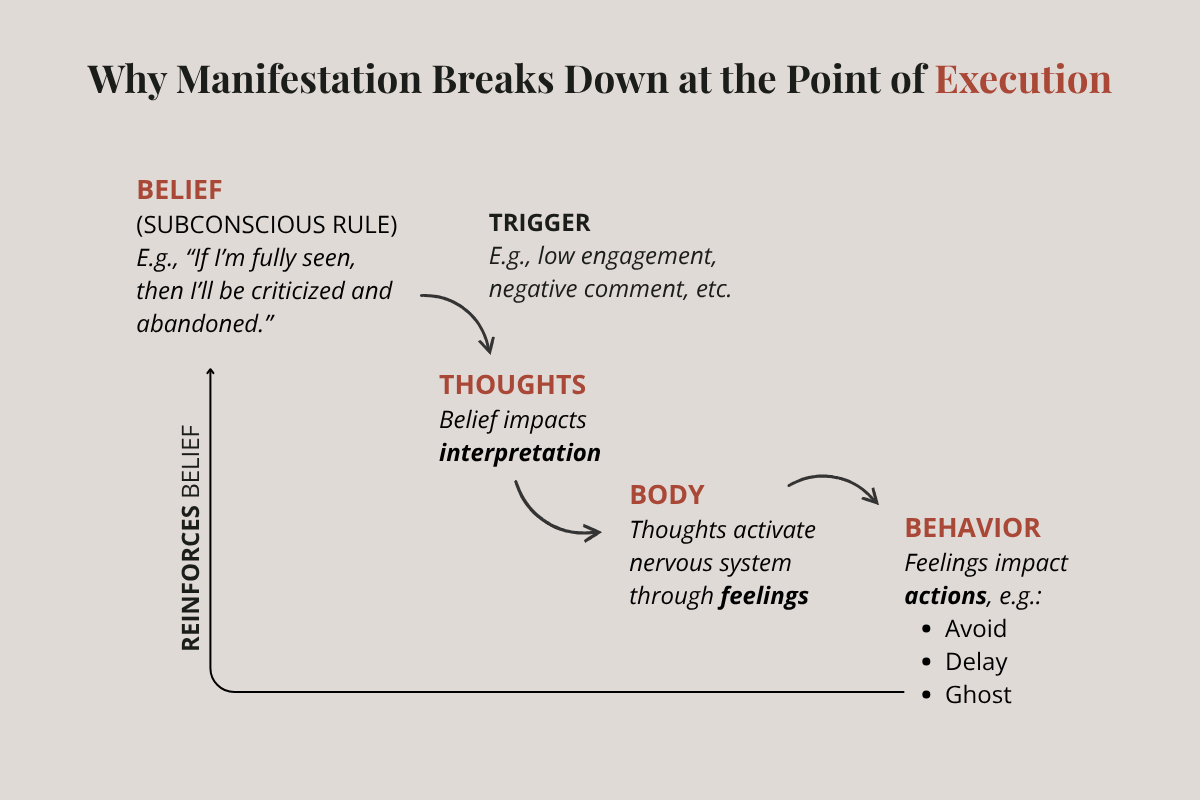
The universe is not withholding your manifestation because you have abundance-repelling "desperate energy." You are stuck in a self-fulfilling subconscious prophecy cycle with three components that you need to address together, not separately or one after another.
That's why even when you force yourself with discipline, you eventually crash and burn out. Or you can have the best strategy in the world and all the tools you need available and still procrastinate.
Because without addressing your subconscious beliefs, your nervous system's response and behavior together, the cycle is very hard to break. Your inner capacity to stay aligned remains capped.
Why Everything You Tried Has a Ceiling
You probably tried some version of these methods already. And to be clear, they are not useless. Most of them can help you feel more aligned, focused, or emotionally available in the moment. But it's important to know where they stop when they only address one part of the pattern.
Affirmations and scripting work at the conscious level.
When you repeat I am magnetic to premium clients or write your future reality in the present tense as if it has already happened, you are working with your thinking mind. This is useful for focus and direction. But the subconscious rules sit below the level of conscious thought. And when a conscious statement directly contradicts a deeper rule, affirmations often don't stick despite repetition. You might remember the sentence, but internally reject the belief and not act according to it if it doesn't fit into your existing subconscious rule set.
Guided visualization (“feeling it real”) asks you to vividly imagine the end result as already achieved, to feel the emotion of already having what you want before it manifests. Because this is a more sensory immersive approach, it's much easier for your system to integrate than affirmations or scripting (repetition).
But on their own, they often don't update the deeper rules you operate by. The destination becomes vivid, but the internal route to consistent action remains unchanged. So the temporary feeling of alignment fades the moment real-life stress shows up because your capacity has never been upgraded. In other words, the desired reality may feel emotionally real for a moment, but your system still is not trained to stay in that reality when execution becomes uncomfortable.
Meditation and breathwork work at the level of the body.
They calm the nervous system, lower activation, and create a window of clearer thinking. While this is valuable, the subconscious rule that triggers the stress response is still intact.
Take 10 deep breaths before a discovery call, and you may feel steadier as you walk in. But if there's a subconscious belief that asking for money makes you greedy or unlikable, it will show up regardless (in the way you hedge the price, over-explain the value, or cave the moment there is any friction).
Managing the stress response without updating what is generating it becomes maintenance rather than lasting change.
Shadow work journaling — the practice of using prompts to uncover the limiting belief, trace it back to its origin, and understand what it is protecting — gives you something genuinely useful: insight.
You can name the subconscious belief, understand where it came from, even feel real compassion for the part of you that formed it. But insight is not the same as change.
You can know exactly what your limiting belief is and still find yourself procrastinating, delaying, or self-sabotaging — because knowing about it and actually rewriting it are not the same. That's why you can spend years understanding the pattern clearly and still stay stuck in the same cycle.
All of these methods have one thing in common: they tend to address one part of a pattern that has three. That is why they can help, but still fall short when the stress of running a business gets loud.
Same Goal, Different Results. Here's Why
Meet Veronica. A brilliant book editor who set the intention to grow her business to 30k per month.
She already had a solid new offer to make this possible, a clear message, and a real audience. She visualized the outcome. She saw herself calling in high-ticket clients and did her meditations and affirmations.
But in her first week after launch, the engagement with it was low. Sales were quiet. No inquiries were made.
So her subconscious read that silence through the lens it had been running on for years: If people are not responding, then I did something wrong. This means the offer is bad, the message is off, or maybe I am not enough.
That interpretation activated a threat response in her nervous system. And from that contracted state, every subsequent decision was made: she rewrote the sales page, softened the price, delayed following up with potential leads, stopped posting, and disappeared for a week to recalibrate. By week three, she was questioning the entire offer and was mapping out a new direction.
But then she realized she was dealing with a pattern, and instead decided to interrupt it by updating her subconscious beliefs and working with her stress response. Because, for the first time, she clearly saw that whenever things went wrong, she immediately blamed herself, even without evidence.
So, instead of changing everything, she simply repeated the launch with the original offer, but with an entirely different energy.
The first week was still quiet, and she felt the same discomfort she did the first time around. But this time, she no longer interpreted that discomfort as a verdict. She felt discouraged, but knew there was not yet enough data to draw any conclusions. She simply continued executing her launch plan. Made one clear offer a day for a month, and adjusted her messaging based on the feedback and information gathered, rather than fear. She focused on consistency rather than on the gap between her intended goal and her current reality.
Three months later, her offer is up and running smoothly, and she's close to manifesting her intended 30k month.
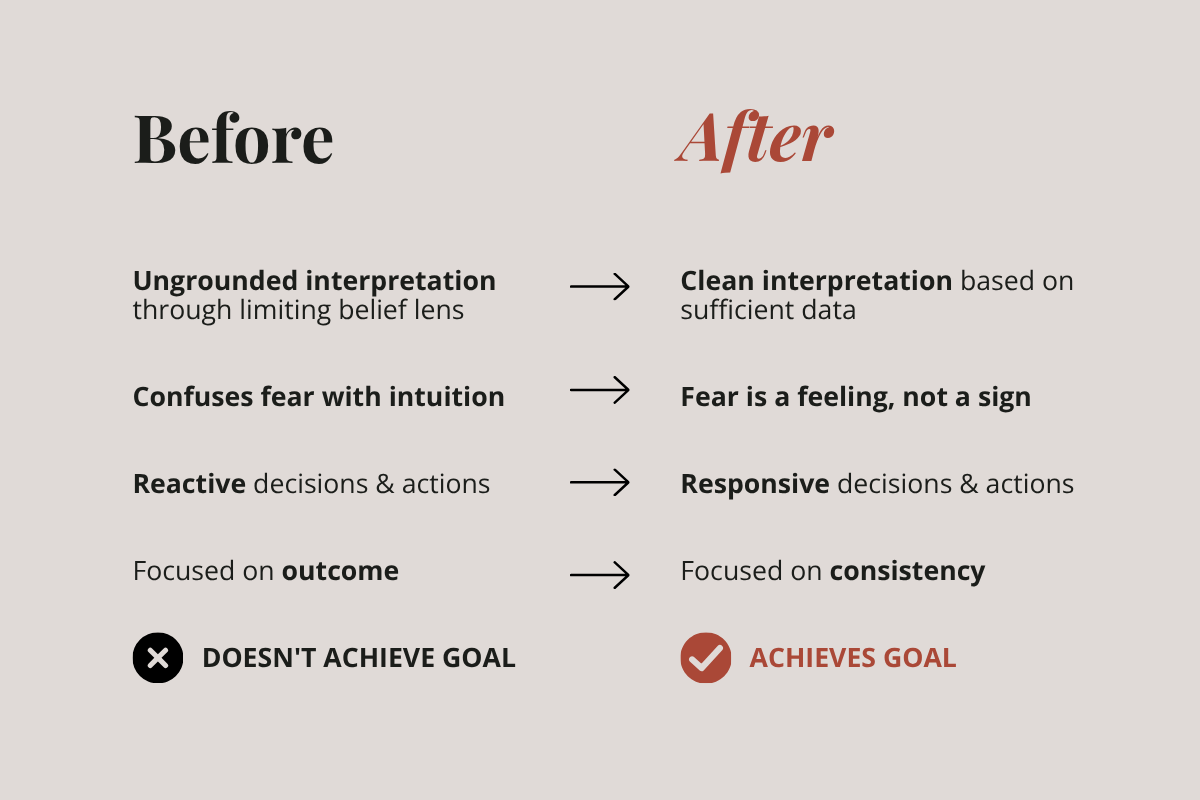
The difference is not that she became a different person, detached from the outcome, did more affirmations, or meditated more. It is that she shifted her limiting belief, which was firing a subconscious threat response that was making every important business decision for her.
Same person. Same goal. Same offer.
Different results over time.
That is why becoming aware of your triggers and limiting beliefs is so important in business. Because they affect your interpretation lens, impact your nervous system, and hence your actions. Dysregulation does not just change your mood. It changes what you notice, what you conclude from it, when you decide to act, and whether you stay consistent long enough for your actions to produce anything worth measuring.
How to Actually Stay in Alignment
You usually become aware of your limiting beliefs and resistance patterns at the point of execution through behavioral clues. Avoidance. Procrastination. Obsession.
Shifting the pattern is not the same as hustling and grinding your way through it. If you push yourself too hard, that approach can backfire and deepen the avoidance, which makes getting started again feel like a steeper uphill battle each time.
To change a resistance pattern requires two entry points:
- Updating the subconscious belief driving the threat response, and
- Rewiring the nervous system response to tolerate the action in the meantime.
Both. Not one or the other, at different times, in separate practices that never talk to each other.
You are probably already familiar with the body-level work to calm your nervous system: a few minutes of breathwork, a short walk, or shaking your body. You can do these exercises before you shift gears between tasks, to ground yourself before important meetings, or when you notice you're triggered to calm down. These interrupt the activation in the moment and create a window of steadier action.
While this is useful, without updating the subconscious rule triggering the nervous system response, you will need to keep regulating yourself before every difficult task. Because your system keeps predicting the same danger and keeps needing to be talked down.
To shift the subconscious rule, you need to actually get into a state where the mind is receptive to new input and quiet.
And this is where most mindset work and manifestation practices fall short: they support awareness, state, or intention, but don't reach the level where the old pattern lives. The subconscious operates beneath the thinking mind.
It is accessible through a brainwave state called theta — when you are half-awake, half-asleep just before drifting off. In that state, the analytical mind quiets down, which makes the subconscious more receptive to installing new rules and updating existing ones.
So how can you reach theta?
One way is through a deep trance-like meditation, but it takes practice. An easier method is through guided hypnosis.
A properly structured hypnosis track does three things at once:
- It calms the nervous system deeply enough to induce a level of focused attention in which subconscious rules can be updated (theta state).
- It delivers targeted suggestions while the analytical mind is quieter, helping shift your limiting beliefs.
- It includes both target and process visualization, which helps you rehearse and internalize the very behavior you might have been avoiding without resistance. So you're not just seeing yourself already having achieved your desired outcome, but also seeing yourself taking aligned action. So when you do it in real life, it gets much easier.
This is how the avoidance pattern begins to dissolve so you can stay in alignment. Not through forcing yourself to push through, ignoring your resistance, or gaslighting yourself into positive thinking. By updating your subconscious belief and repeatedly experiencing the opposite of what your old if-then rule predicted would happen.
That is how neuroplastic change happens: the brain rewires itself in response to repeated evidence of what actually happened, not just through insight about what might be true. That's why it's more sustainable and effective to take small, repeatable actions around what you tend to avoid in a regulated nervous system state than to force yourself to do the whole thing in one go when you're stressed. Because you're spoon-feeding your nervous system the repeated evidence it needs to fully integrate the new rule.
The Thing You Know Now That Changes Everything
You came to this post thinking the problem was your vibration, your attachment, your unhealed blocks, or your level of trust in the process. Maybe you thought you needed more healing, meditation, or surrender. But if any of that were true, then there shouldn't be so many unhealed, "low-vibrational" people in the world who are clearly attached to their desires yet are excellent manifestors.
What you know now is that what keeps pulling you out of alignment and certainty is baked into a three-layered, interdependent system consisting of your subconscious rules, nervous system response, and your behavior.
When you work on the first two together, the third one follows. When you try to only change one individually, it doesn't work because they're interconnected.
Your vision does not need more force.
It needs an operating system that can hold it.
The gap between wanting and having is closed through consistently aligned action
It depends on your being able to stay in the room when you feel triggered.
It depends on your capacity to tolerate discomfort long enough for your actions to compound into a business that actually grows.
And that capacity relies on your subconscious beliefs.
That insight alone changes what you do tomorrow morning.
Whether you recognize a strategy problem or a stress response in disguise.
Whether you rewrite the offer for the third time or just send the email you already drafted.
Whether you interpret a quiet week as something being wrong, or as not meaning anything yet, because you know you do not have enough data.
You are not bad at manifestation.
You are running on a system that learned rules for protecting you at a time when you did not know how to protect yourself — and it has not been updated yet.
That update is available.
It just lives at a different layer than most people are told to look.
And if this article clarified why mindset work, visualization, or nervous-system tools have only taken you so far, Magnetic Mind is the next step for exactly that reason.
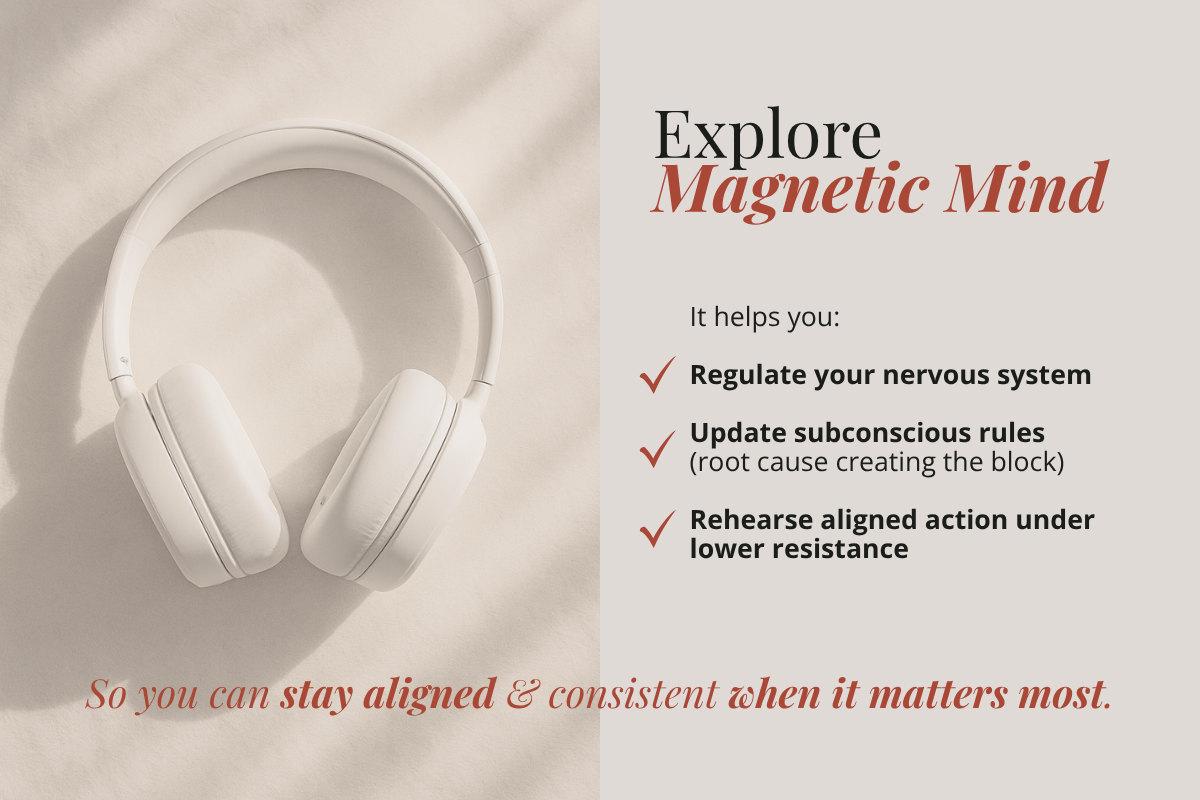
If you want to go deeper, Magnetic Mind is a library of 12 targeted hypnosis tracks created for founders who know what to do but keep losing access to aligned execution when the stakes feel high. Each track is designed to help regulate the nervous system while updating the subconscious rule beneath the pattern — whether it's blocks around visibility, money, or growth that keep you playing small.
Explore Magnetic Mind →
